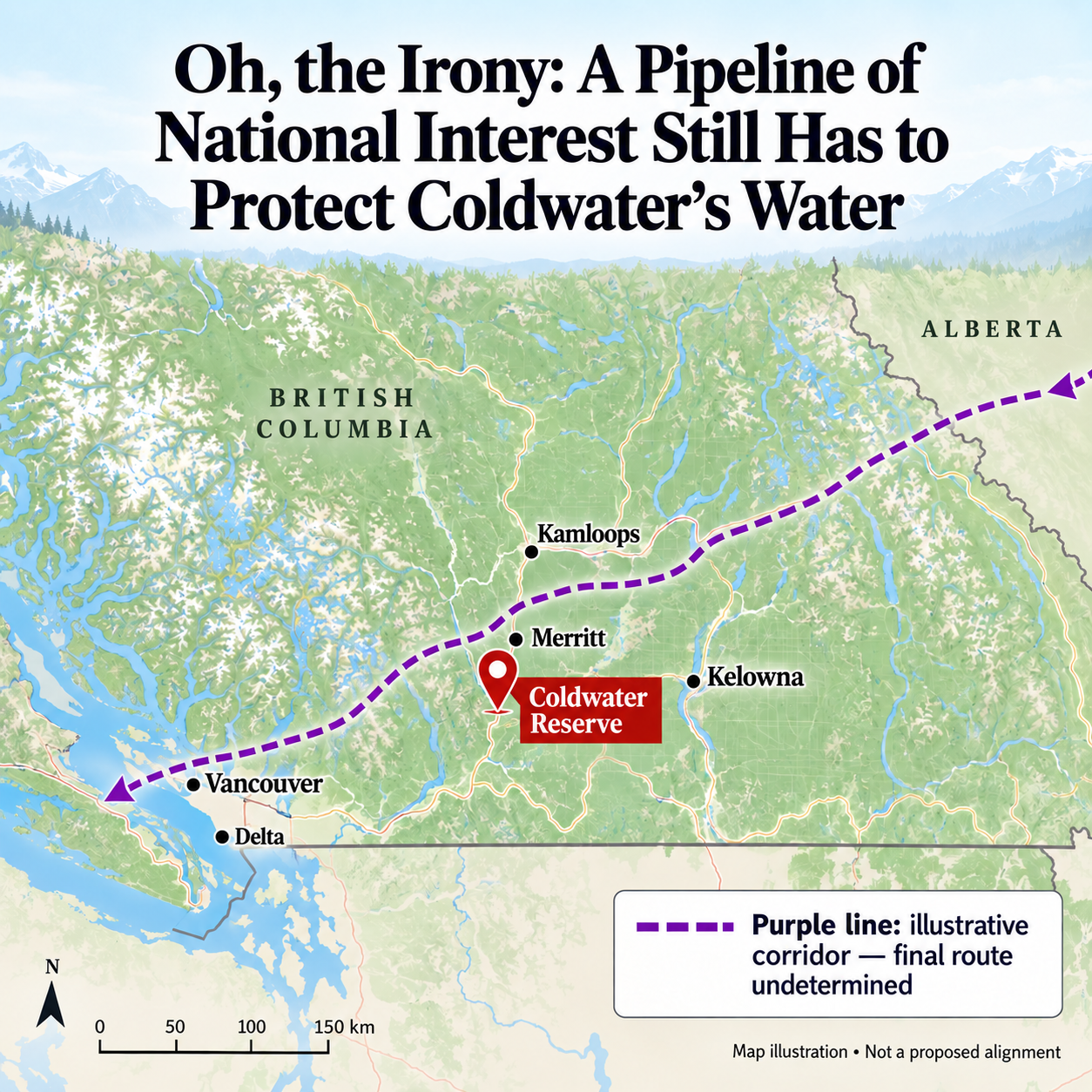

Canada is considering whether a new Alberta-to-B.C. oil pipeline should be designated a project of national interest. Its final route has not been chosen. That matters, because before anyone can judge the risk to a particular water source, we need to know whether the proposed route goes anywhere near it. (alberta.ca, castanetkamloops.net)
Still, one familiar issue deserves attention now. The Coldwater Indian Band previously objected to a proposed Trans Mountain expansion route because it feared a spill could contaminate the aquifer supplying its reserve. The band’s evidence described two community wells and several smaller private wells. It said the aquifer was the sole source of drinking water for most residents on the Coldwater Reserve. This was an objection to Trans Mountain, not proof that Coldwater has objected to the route of the newly proposed pipeline. (docs2.cer-rec.gc.ca, projects.eao.gov.bc.ca)
According to Indigenous Services Canada, Coldwater had 952 registered members at the end of 2024. Of those, 377 lived on reserve or Crown land and 575 lived off reserve. The 377 figure is not a count of people confirmed to draw from the aquifer. (sac-isc.gc.ca)
I can hear the question already: How could a community of a few hundred people potentially hold up a pipeline promoted as being in the national interest? Here we are in Canada in 2026, and it is a fair question to ask. Major projects affect millions of Canadians. Delay has a cost, too. Moreover is no me else worried about their ground water?!
But the answer cannot be that 377 people should simply accept an unexamined risk to their water. The size of a community does not tell us whether a pipeline route is safe. Nor does a concern about water mean any one community has an automatic veto over every possible route.
There is another distinction worth making. Federal figures dated September 10, 2026, showed no active long-term drinking-water advisories on public on-reserve systems in B.C. That does not prove every Coldwater household or private well has reliable, safe water. I could not verify that. It does mean we should describe the band’s documented concern accurately: protecting an aquifer it relies on from a potential future spill. B.C. short-term advisories are tracked separately by the First Nations Health Authority. (sac-isc.gc.ca, sac.gc.ca, docs2.cer-rec.gc.ca)
What makes no sense to me is allowing a water issue to become an indefinite argument with no clear public test. If a proposed pipeline route approaches Coldwater’s aquifer, publish the groundwater studies. Identify the wells, groundwater flow, credible spill scenarios, detection times and response limits. Put alternative routes beside it. Give Coldwater the opportunity to challenge the findings, then require the proponent and regulators to make a decision on the evidence.
If a route puts the drinking-water supply at unacceptable risk, change the route. If the risk can be properly addressed, explain how and move forward. Canadians should expect both a serious assessment and a timely answer.
A project of national interest should be able to meet that standard. Oh, the irony: the stronger the national case for building this pipeline, the stronger the obligation to settle a local water question with evidence instead of leaving everyone stuck in another years-long fight.
Leave a Reply