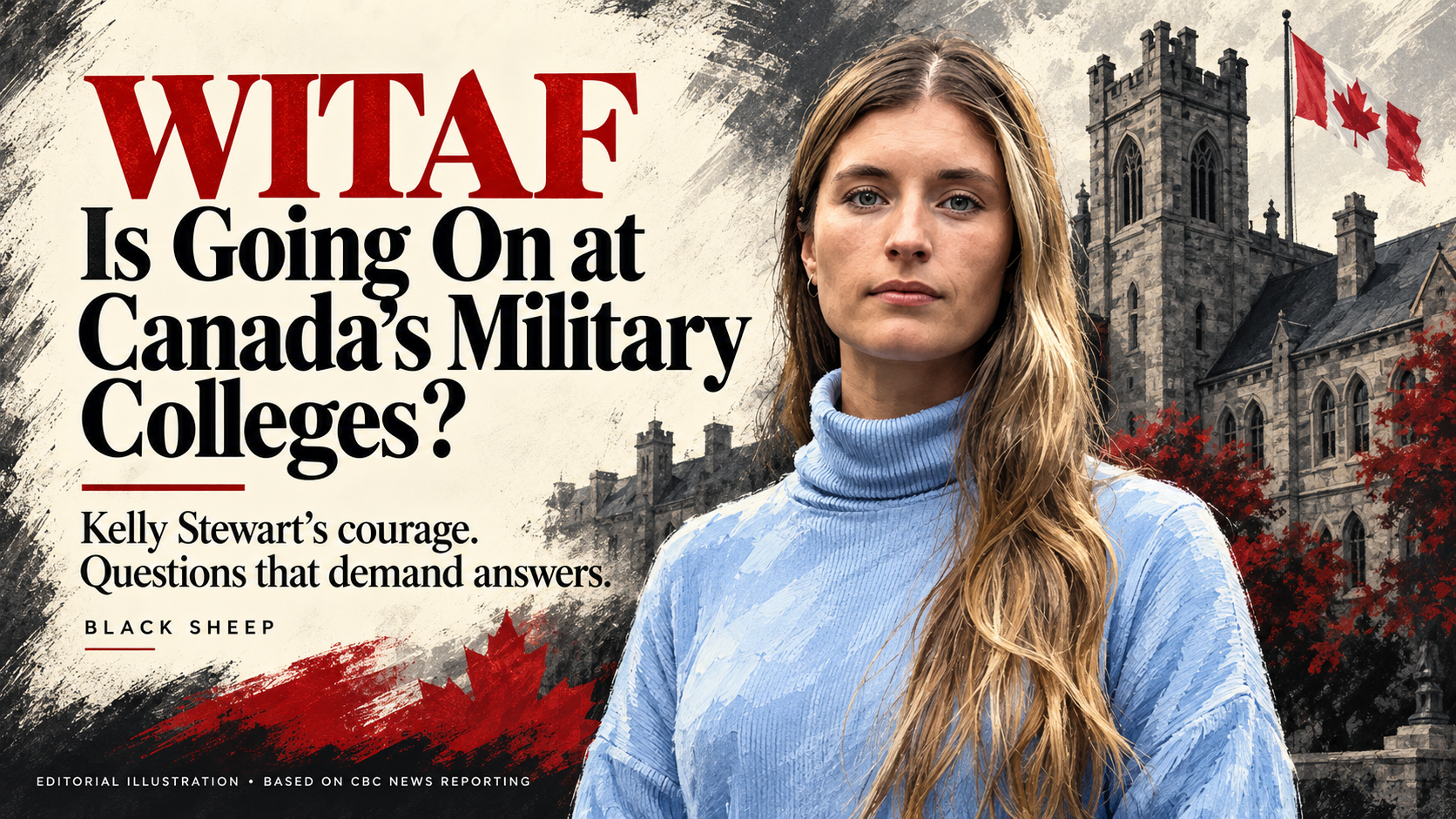
Kelly Stewart has spoken publicly. Canadians deserve answers about how she was treated.
By Black Sheep

WITAF is going on at Canada’s military colleges?
That is my reaction to CBC journalist Kayla Hounsell’s reporting on Kelly Stewart. It takes strength to put your name and face beside an experience this personal, knowing strangers will scrutinize your account.
Kelly deserves respect for doing it. She also deserves something more useful than being called brave: serious scrutiny of the institutional response.
A hidden camera. An investigation. No charges.
According to CBC, Stewart discovered a webcam concealed in her Royal Military College dorm room in October 2018. Military police investigated; the case closed in August 2020 for insufficient evidence, with no charges laid.
CBC reports that investigative records show a month passed before hallway surveillance footage was accessed. Stewart says police took more than four months to seize the suspect’s laptop. She alleges superiors minimized her distress and discouraged seeking mental health support. Her release records, reviewed by CBC, connect her departure to harmful and inappropriate sexual behaviour. A complaint about the investigator is being processed by the Military Police Complaints Commission.
DND declined an interview and cited privacy and legal constraints on individual cases. It acknowledged shortcomings in safety standards and described reforms. These are reported allegations and records, not findings of criminal guilt.
Where was the duty of leadership?
A military college prepares people to exercise authority over others. I expect that responsibility to begin with the people living and studying inside its own walls.
A student reporting a concealed camera should receive a prompt investigation, a clear explanation of the process and a practical safety plan. She should be able to ask for help without wondering whether doing so will damage her future.
If Stewart’s account of the response is accurate, the question extends beyond who installed a camera. It reaches the decisions made after she reported it.
Who assessed her safety? Who checked whether the arrangements were working? Who took responsibility when her ability to continue studying deteriorated?
Those are questions about leadership. They deserve answers independent of whether a criminal charge could be proved.
Insufficient evidence deserves scrutiny, too
An investigation ending without charges does not establish that a suspect committed an offence. It also does not, by itself, demonstrate that every investigative decision was sound.
We must keep both points in view.
The appropriate response is to examine the work: what evidence was sought, when it was secured, what could still be recovered and how decisions were documented. Any review should assess those issues fairly, including explanations investigators offer for the timing.
I want the evidence to determine the conclusions. That requires enough transparency to evaluate the process.
Courage should lead to accountability
I respect Kelly for speaking publicly. But praising her courage cannot become the institution’s substitute for answering her concerns.
The people responsible for a student’s welfare hold authority, resources and access to information. A student should not have to become a public advocate years later to get a clear account of how those powers were used.
Nor should support depend on a conviction. A fair investigation and meaningful care for the person making a report can proceed together.
The questions that need answers
- What explains the reported delay in obtaining hallway surveillance footage?
- What steps were taken to preserve relevant digital evidence, and when?
- What safety and accommodation options were offered to Stewart, and how was their adequacy assessed?
- Will an independent review examine both the investigation and the response of her chain of command?
- What can be disclosed about the findings and corrective action while protecting legitimate privacy interests?
Kelly has taken the difficult step of putting her experience before the public.
My view is straightforward: listen seriously, examine the records fairly and require the institution to account for its decisions.
Respect her courage. Answer her questions. Show the work.
— Black Sheep
Source: Kayla Hounsell’s CBC News report, via Apple News, October 16, 2026.
The cover depicts Kelly as an editorial illustration based on her published portrait, with the headline.

Black_Sheep_Kelly_Stewart_Military_Colleges.md
Leave a Reply