Black Sheep — September 20, 2026

First, here is the RCMP’s public account of the fire at our home. In its January 23, 2026 news release, “Police investigate residential arson”, Castlegar RCMP reported that, shortly before 1 p.m. on January 22, an unknown man allegedly set fire to a red fuel can on our front porch and threw a Molotov cocktail through the front window. It said the homeowner tried to extinguish the flames while another resident called 9-1-1. Police asked the public for footage of two suspicious men and a white SUV or longer sedan.

The January 23 release did not describe the fire as a targeted attack. It also did not say that I went to hospital. After I came out of the house, I had black smoke on my face and in my nostrils. As I recall it, an RCMP officer recommended that I seek medical attention actually and get into the ambulance which he took me too and he was a very large black guy whom I don’t know his name but he was black as was I at the time so I remember it well how that went down. I went to hospital via ambulance which btw has cost me $80 actually, adding insult to injury, for smoke inhalation and stayed overnight. Those details are my account of what happened; they were not included in that release.
The omission of “targeted” stands out to me because police had spoken to me about a reported threat to my life two months earlier. In November 2025, information about an alleged plot involving me and other named people was reported to police in Mission and Langley. On November 19, a Castlegar RCMP officer warned me about a threat. I understood that conversation to be a Duty to Warn, and I say I was later told that was what it had been. Yet when RCMP officers spoke to the investigator reviewing my body armour application, they said no official Duty to Warn had been issued.
I want police to explain both accounts: what they knew about the November threat when they issued the January 23 release, and why officers later disputed the status of the warning I received. The earlier warning does not, on its own, establish who attacked our home or prove that the reported plot and the arson were connected.
The day after the fire, Deputy Registrar Alysha Hardy approved my 90-day body armour exemption, stating that she was satisfied there was an imminent risk to my safety. That approval came nearly eight weeks after her office received my application—and one day after my daughter and I were inside our home when it was set on fire.That distinction mattered to me. I had been told of an alleged plan to kill me near the Castlegar gym I attended regularly. As I recall it, the practical advice police gave me was to stay away from the gym. I was frightened and wanted body armour for protection.
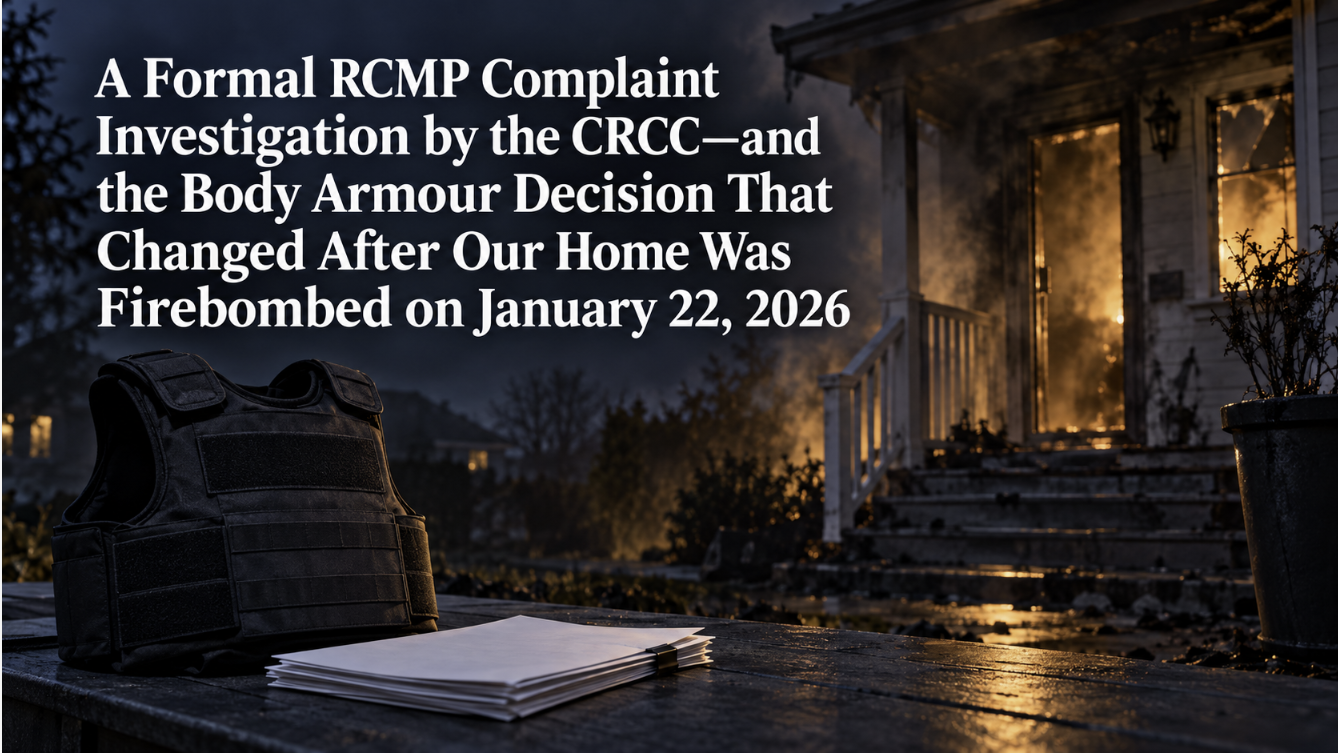
On January 22, 2026, someone firebombed our Castlegar home while my daughter and I were inside. I watched the attackers from near our front door as they approached the house and threw incendiary devices. The next day, Deputy Registrar Alysha Hardy approved my 90-day body armour exemption, stating that she was satisfied there was an imminent risk to my safety.
Hardy had approved Jessica Simpson’s exemption on November 28, 2025, four days after the application date recorded in Jessica’s letter. I am not aware of Jessica having received a Duty to Warn. My application was received December 1 and remained under review for nearly eight weeks. On January 8, Hardy told me she was considering refusing it. She approved it on January 23, the day after the attack on our home.
CRCC INVESTIGATION
I have a September 2026 letter confirming that a formal investigation into a public complaint about RCMP conduct is ongoing. The complaint concerns the handling of information about the reported threat. I believe police mishandled that information, and I want the decisions made before the attack examined against the original records.
What is the CRCC—and what does the September 2026 letter say?
The Civilian Review and Complaints Commission for the RCMP, or CRCC, is an independent federal agency that receives complaints about RCMP members’ conduct. In most cases, the RCMP investigates a complaint first. After the RCMP issues its decision, a dissatisfied complainant can ask the CRCC to review the investigation.
The September 2026 letter is from Mission RCMP. It confirms an ongoing RCMP investigation into a conduct complaint; it is not a CRCC finding. The letter is signed by a staff sergeant identified as the detachment’s Acting Officer in Charge. I am withholding both the staff sergeant’s name and the complainant’s identity from this post.
The letter says a “Formal Investigation” was requested into the allegations in the public complaint. It states: “The investigation is ongoing.” It does not identify a member under investigation, announce a finding, establish that the alleged murder plot was real, or establish who firebombed our home.
The central question should be answerable from police records: What information did Mission RCMP receive about the reported threat, when did Langley and Castlegar RCMP receive it, and what did each detachment do with it?
A change in Mission RCMP leadership. Connected to all of this? I think so!!
Ted Lewko – Mission RCMP Inspector Moving On – May 5th 2026
On May 5, 2026, Mission RCMP published a news release titled “Mission RCMP’s Inspector Lewko moving on”. It says Inspector Ted Lewko had commanded the detachment since 2022 and that his last day in Mission would be May 7. According to the release, he was promoted to Superintendent and would move to Burnaby as an Operations Officer. The RCMP said it had begun selecting Mission’s next Officer in Charge.
Lewko led Mission during the period when information about the reported threat was brought to police. By September, the response to the conduct complaint was signed by an Acting Officer in Charge. I want to know whether any leadership or staffing changes affected the handling of this matter. I have no evidence that Lewko was fired or that his transfer resulted from the complaint.

Photo caption: Inspector Ted Lewko. Source: Mission RCMP, May 5, 2026.
My belief is that the RCMP is in clean up mode at the Mission RCMP and that this is also linked to the “relieving of his duties” of the Deputy Commissioner of BC RCMP on August 13 2026. See that news here: https://rcmp.ca/en/news/2026/08/4355904 and https://www.cbc.ca/news/canada/british-columbia/dwayne-mcdonald-allegations-relieved-duties-9.7306665

The warning of threats to my life —and what unnamed RCMP officers in Langley RCMP detach and Castlegar RCMP later said about it:
On November 19, 2025, a very very junior Castlegar RCMP constable named Cst Finnigan spoke to me about a reported threat. I understood the conversation as a Duty to Warn. He told me there was an imminent threat to my life and asked if I knew anyone who wanted to harm me to which I responded yeah a trapline of them like Michael Martinz, his x fiance Svetlana Dalla Lana and Danny Keith Martin to start. When I later responded to the body armour investigator, I identified Constable Finnigan as the officer who had spoken to me and supplied the police file number I had been given.
The December 4, 2025 investigative report records a sharply different account from three RCMP officers:
Langley RCMP constable, speaking to the investigator on December 2:
“DROVER was not issued an official Duty to Warn.”
Castlegar RCMP sergeant, speaking to the investigator on December 2:
“A constable had spoken with DROVER regarding an allegation that someone was going to harm DROVER, but it was not an official Duty to Warn.”
The report says the sergeant assessed the risk as low. Like WITAF!!!
NOTE: this is absolutely a blatant lie by this unnamed RCMP (no wonder he or she was unnamed right?!) because on November 25 2025 on a recorded phone call with Jessica Yaniv who initiated the call with myself and Cpl Von Colditz of the Castlegar RCMP outright told the both of us that I was served a Duty To Warn on November 19th 2025 as he was reading it from the file notes
Alos in this body armour report in an email received December 4, 2025, a corporal with Langley RCMP explained the following:
The Langley RCMP has determined there is no imminent, credible threat to DROVER’s safety. The investigation is ongoing and the RCMP will notify the appropriate people and take necessary action, should any new information arise.
I received this same quote via email from this same Langley RCMP corporal, received Janaury 12, 2026 (10 days before the firebombing):
“The Langley RCMP has determined there is no imminent, credible threat to DROVER’s safety. The investigation is ongoing and the RCMP will notify the appropriate people and take necessary action, should any new information arise.”
The report does not name that Langley constable, Castlegar sergeant, or Langley corporal. It records their ranks and detachments, but I cannot tell from the report which officers made these statements, what records they reviewed, or who decided the risk was low. The investigator’s list of information sources refers to phone calls with Castlegar and Langley RCMP; it does not supply the officers’ names.
I dispute the police description of the November conversation. If their position is that I was warned about someone harming me but was not given an official Duty to Warn, I want them to explain that distinction. Who decided how to classify the warning? When? Did that classification affect their risk assessment or the protective steps offered to my family?
I also want to know why these officers were unnamed in a report that was used to assess my body armour application. I am concerned that the conflicting accounts may have minimized the warning I received. Their omission from this report does not, by itself, prove a cover-up or show why their names were left out. The original police notes, the investigator’s call notes, and the December 4 email should identify the people involved and allow their accounts to be checked.
The report’s summary adopted the police account: Castlegar RCMP confirmed that an officer spoke to me about an allegation that someone would harm me, but said no Duty to Warn had been issued. It also repeated Langley RCMP’s conclusion that there was no credible imminent threat. The investigator recommended that the Deputy Registrar consider refusing my exemption.
BODY ARMOUR DECISION Jessica’s approval and my wait
The two body armour approval letters were signed by the same decision maker: Alysha Hardy, Deputy Registrar, Security Services. Their dates tell the story:
| Date | Documented event |
|---|---|
| November 24, 2025 | Jessica Simpson applied for a 90-day body armour exemption, according to her approval letter. |
| November 28, 2025 | Hardy approved Jessica’s exemption, stating that she was satisfied there was an imminent risk to Jessica’s safety. |
| December 1, 2025 | The Security Programs Division received my application for a 90-day exemption. |
| December 4, 2025 | The investigator completed the report recording the unnamed officers’ statements and recommending that refusal be considered. |
| January 8, 2026 | Hardy notified me that she was considering refusing my application for lack of satisfactory documented evidence of imminent risk. She invited my response by January 23. This was not a final refusal. |
| January 12, 2026 | Corporal Amanda Martell emailed me Langley RCMP’s assessment that there was “no imminent, credible threat” to my safety. |
| January 22, 2026 | Our home was firebombed while my daughter and I were inside. |
| January 23, 2026 | Hardy approved my exemption after reviewing my submission about the incident at our residence. The approval email reached me at 3:40 p.m. |
Jessica’s November 28 letter says Hardy was satisfied there was “an imminent risk to your safety.” My January 8 letter said Hardy might decline my application because of “a lack of satisfactory documented evidence of an imminent risk.” The investigative report accompanying my letter marked “Refuse To Grant Exemption” for Hardy’s consideration.

I question why Jessica’s application was approved within four days while mine remained under review until after the firebombing. I also want to know what evidence and background checks were considered in each case. The letters alone do not establish that the applications contained the same evidence or explain the difference in processing times.
[Insert Jessica Yaniv’s correspondence with Alysha Hardy’s office here, with its date and sender shown and personal contact details redacted.]
Document caption: Correspondence concerning Jessica Yaniv’s body armour exemption. If using a cleaned-up image, label it as an edited reproduction and retain the original for verification.
Who is Alysha Hardy?

Hardy is identified on the body armour letters as Deputy Registrar, Security Services. The International Association of Security and Investigative Regulators (IASIR) lists her as Director and Deputy Registrar of Security Services with British Columbia’s Security Programs Division and as one of its Directors at Large.
Hardy is the named decision maker in the approval letters. I want to know what evidence was presented to her for each application, what police told her office, and what changed between her January 8 notice and January 23 approval. Her IASIR position does not itself suggest wrongdoing or indicate that the association was involved in either decision.
[Insert Alysha Hardy’s portrait here]
Photo caption: Alysha Hardy, listed by IASIR as a Director at Large and as Director and Deputy Registrar of Security Services with British Columbia’s Security Programs Division. If using the portrait illustration, label it “Illustration based on Alysha Hardy’s IASIR profile photo.”
Corporal Martell’s January 12 assessment
At 1:15:26 p.m. PST on January 12, 2026, Corporal Amanda Martell emailed me under the subject “RE: Body Armour Permit.” She said she was sharing correspondence provided to the Ministry of Public Safety and Solicitor General:
“In reference to Mr. Drover’s request under the Body Armour Control Act, at this time the Langley RCMP has determined, there is no imminent, credible threat to Mr. Drover’s safety. The Langley RCMP is continuing this investigation, and should any new information arise, the RCMP will notify the appropriate people and take the necessary action.”
She also directed me to consult a civil lawyer about my concerns regarding an online identity and disputes with others. The email was signed “Cpl. Martell.”
Martell communicated Langley RCMP’s threat assessment to me and, according to her email, to the ministry considering my body armour application. Her communication is central to the questions I am raising. The September 9 Mission RCMP letter does not identify her as a member under formal investigation.
Martell later told me by phone, as I recall it, that officers had investigated the alleged murder plot and found no credible basis for it. I recall her saying there had “100%” never been an imminent threat to my life. That is my account of a phone call; the call notes or a recording should be examined before those words are treated as a verified quotation. I also understood her to say police were examining whether the allegation had been fabricated. I have not seen a current police record establishing the scope or status of that inquiry.
January 22 changed the body armour decision
Hardy’s January 23 approval letter makes the change in her assessment explicit. She writes:
“I have reviewed the submission you provided on January 23, 2026, regarding an incident of concern that occurred at your residence and had been reported to police.”
She then states:
“I am satisfied there is an imminent risk to your safety.”
The letter granted me a 90-day exemption expiring April 23, 2026. The ministry’s accompanying email, sent at 3:40 p.m. on January 23, says:
“Please find attached approval letter for Body Armour Permit 90-day exemption.”
That was one day after the firebombing and eleven days after Martell’s January 12 email. Hardy’s letter ties the approval to the incident at our residence. It does not say the ministry concluded that the alleged November plot was real.
Why did an attack on our home occur before my application was approved? Answering that question requires the complete record of what Hardy’s office knew at each stage, including the information police supplied and the reasons for both decisions.

What the CRCC investigation must examine
I believe the RCMP botched its response to the reported threat against my life and that is an understatement. Officers warned me in November 2025, then told the body armour investigator that no official Duty to Warn had been issued and that the risk was low. My application remained unresolved until after our home was firebombed with my daughter and me inside. Calling that sequence troubling is an understatement.
In my view, these decisions raise serious questions about RCMP misconduct and negligence. I believe the handling of the threat left my family exposed to an attack that might have been prevented with an effective investigation and safety plan. The full police records are needed to establish what officers knew, what they did, and whether any failures contributed to the firebombing. I intend to examine the grounds for seeking damages in court.
The conduct complaint investigation must establish:
- What Mission RCMP received about the reported threat in November, when Langley and Castlegar RCMP received it, and what each detachment did with it.
- What Constable Finnigan told me, how the November 19 warning was recorded, and why other officers later denied that it was an official Duty to Warn.
- What was said during the November 25 call involving Corporal Von Colditz, Jessica Yaniv, and me, and how it compares with the original police notes and the December 4 report.
- Who the unnamed Langley constable, Castlegar sergeant, and Langley corporal in the December 4 report were; what records each reviewed; and why their names were omitted.
- What evidence supported the December and January assessments that there was no imminent, credible threat.
- What investigation and safety planning police undertook for me and my family before January 22.
- What police told Alysha Hardy’s office about the threat, and how that information affected my body armour application.
- Whether any leadership or staffing changes at Mission or Langley affected the handling of these matters.
- What evidence, if any, connects the reported November threat to the January firebombing. The criminal investigations and the conduct complaint must each answer the questions within their scope.
I ask that the November warning notes, November 25 call recording, communications between detachments, body armour correspondence, and safety assessments be preserved and examined. They are the records needed to test the conflicting accounts.
Here is the sequence that demands an explanation: Hardy approved Jessica Simpson’s exemption on November 28. My application remained under review. Unnamed RCMP officers told the body armour investigator that I had not received an official Duty to Warn and that the risk was low. On January 12, Langley RCMP again told me it saw no imminent, credible threat. On January 22, our home was firebombed. On January 23, Hardy approved my exemption because she was satisfied there was an imminent risk.
I want the original records examined, the officers’ conflicting accounts tested, and the decisions made before the attack accounted for. My daughter and I lived through the consequences. I will pursue accountability, seeking all legal means if the evidence supports a claim for damages.
Leave a Reply