BLACK SHEEP | September 16, 2026

Seriously.
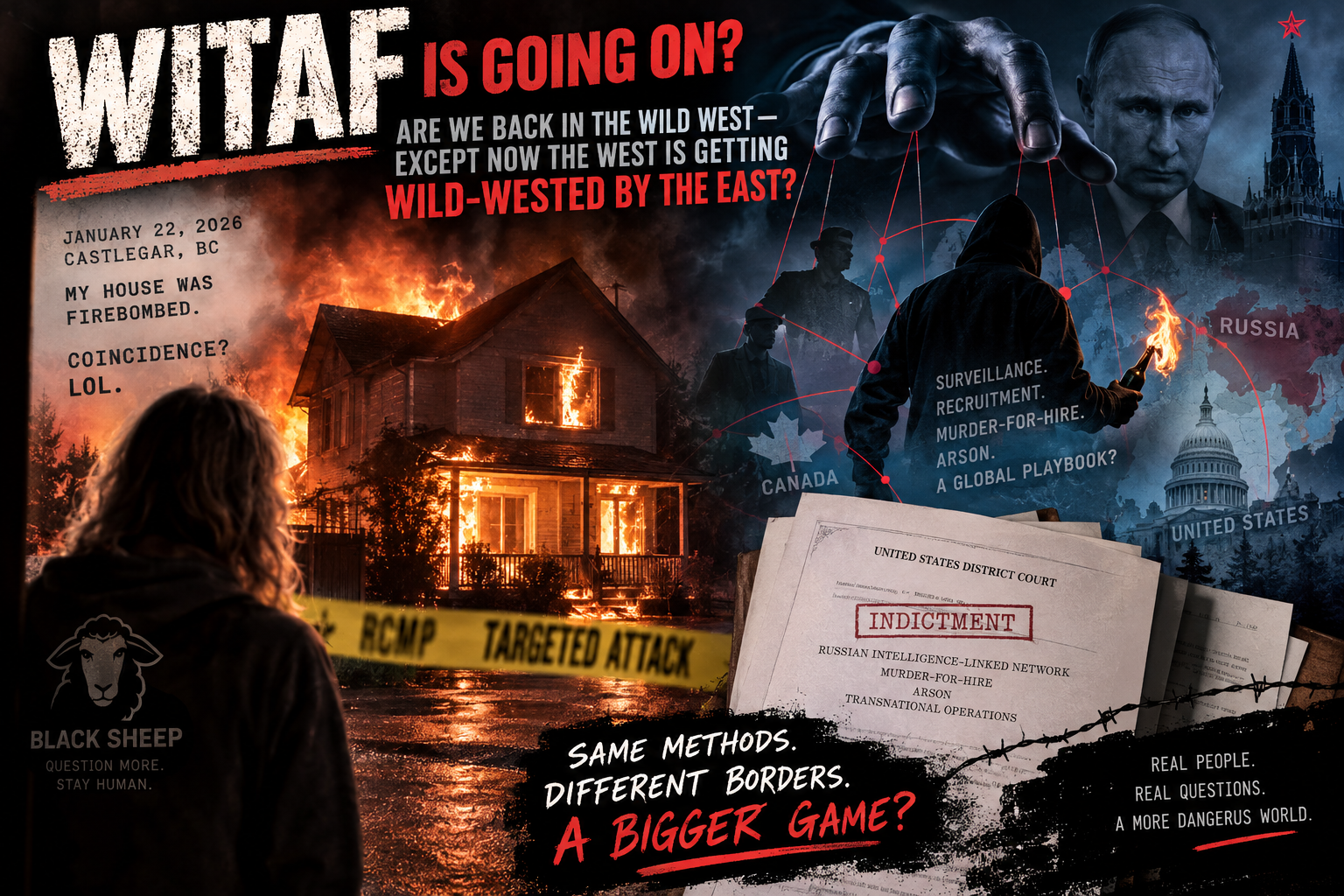
WITAF is going on?
I opened Sam Cooper’s latest The Bureau story this morning and wondered whether I’d somehow fallen into a Cold War spy novel.
Except this isn’t fiction.
And it isn’t 1978.
It’s 2026.
The U.S. Department of Justice has charged five men who prosecutors allege participated in a Russian intelligence-linked network that recruited people to conduct surveillance, sabotage and murder against Russian dissidents and other targets.
These remain allegations, and the accused are presumed innocent unless proven guilty.
But holy shit — look at what prosecutors are alleging.
$1,500 to Watch Someone. $40,000 to Make Them Disappear.
According to the indictment, a recruit in the United States was allegedly offered roughly $1,000–$1,500 to photograph and videotape locations associated with a Russian dissident believed to be in the Washington, D.C. area.
Then came the bigger proposition:
$40,000 to “eliminate” or “disappear” the target.
When the recruit hesitated, one alleged recruiter reportedly said he had “people in Mexico” waiting to do the work.
Apparently the Wild West didn’t disappear.
It got encrypted messaging.
Then Comes the Gasoline
Another allegation really got my attention.
Prosecutors say that in Europe, an alleged Russian intelligence figure offered an American approximately $25,000 to kill another target and allegedly suggested methods including throwing “a bottle of gasoline” or using a knife.
When the American refused, prosecutors say he was offered other jobs involving setting fires and attacking infrastructure.
Think about that.
You don’t necessarily need James Bond.
You need someone willing to take money, conduct surveillance and carry out violence using incredibly simple methods.
That is what makes alleged networks like this frightening.
And Then There’s My Front Door
This is where the story becomes surreal for me.
On January 22, 2026, my family’s home in Castlegar, British Columbia, was firebombed.
Multiple incendiary devices were thrown at the house while my daughter and I were inside.
The RCMP subsequently publicly described what happened as a “targeted attack.”
So now I’m sitting here reading a U.S. federal indictment describing alleged recruitment, surveillance, murder-for-hire, sabotage and the use of gasoline and fire against targets.
My house was firebombed.
Coincidence?
LOL.
Maybe.
And I mean that seriously: maybe it is completely coincidental.
I have no evidence establishing that the Russian network described in this indictment had anything whatsoever to do with the attack on my home, and I am not claiming that it did.
But after what happened to my family, stories like this hit very differently.
Before January 22, somebody describing remotely recruited operatives, surveillance, intermediaries and crude incendiary attacks might have sounded like Hollywood.
Not anymore.
The Question Isn’t Always Just Who Lit the Match
There’s another lesson buried in this indictment.
When something happens, investigators obviously need to identify the person who physically committed the crime.
But sometimes there are additional questions:
Who selected the target?
Who knew the target’s movements?
Who communicated with whom?
Who supplied information?
Was money exchanged?
And was somebody standing behind the person who actually showed up?
Those are questions.
They are not conclusions.
That’s an important distinction.
Because the American indictment demonstrates something remarkable: what appears to be a local criminal act can allegedly be part of a chain stretching across multiple countries.
Welcome to Hybrid Warfare
This is the bigger story.
Modern conflict doesn’t necessarily arrive with tanks crossing your border.
It can involve sabotage.
Cyberattacks.
Disinformation.
Organized crime.
Surveillance.
Intimidation.
Proxy actors.
And, according to these U.S. allegations, potentially even outsourced assassination.
The person carrying out the crime may be several layers removed from whoever allegedly wanted it done.
That’s why Canada should be paying very close attention to what’s happening south of the border and across Europe.
Not every arson, threat or violent crime is foreign interference.
Obviously.
But neither can Western governments operate under the assumption that foreign intelligence operations stop politely at our borders.
The Global Wild West
Maybe we’re not going back to the Wild West.
Maybe we’ve created something considerably stranger:
The Global Wild West.
The wanted poster becomes an encrypted message.
The bounty becomes an electronic payment.
The gunslinger becomes a disposable intermediary.
And whoever allegedly ordered the operation could be sitting thousands of kilometres away.
Five men have been charged in this American case. They have not been convicted, and the allegations must be proven in court.
But the allegations alone should make Western governments ask some uncomfortable questions about transnational repression, foreign interference and outsourced violence.
And after watching my own home burn following what the RCMP publicly called a targeted attack, I’m certainly not going to dismiss those questions as something belonging in a spy novel anymore.
Because apparently in 2026 the Wild West isn’t somewhere out West.
It’s everywhere.
And seriously…
WITAF is going on?
Source: Sam Cooper, The Bureau, “Russian Intelligence Network Plotted To Kill a Dissident In D.C., and Claimed Hitmen Waiting in Mexico, US Prosecutors Allege,” September 16, 2026.
The underlying criminal allegations are contained in a U.S. federal prosecution. All defendants are presumed innocent unless proven guilty.
Leave a Reply